

The real estate market in Dubai has seen a steady increase in property demand, driven by the country’s strategic location and the government’s proactive efforts to attract foreign investors.
As a result, the market has become more competitive, with developers offering attractive payment plans and incentives to attract buyers.
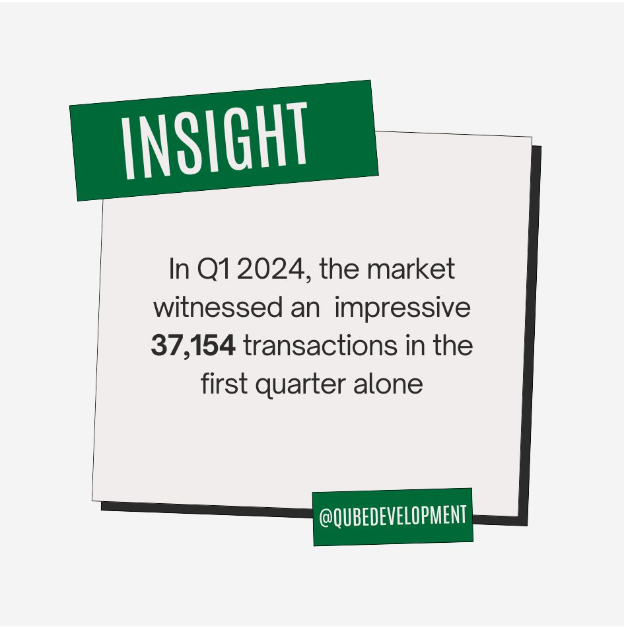
The market shows no signs of slowing down, with an impressive 37,154 transactions in the first quarter alone, amounting to AED 109.85 billion.
In this article, we’ll look at the current state of the Dubai real estate market and discuss trends you should be aware of if you are planning to buy a property in Dubai.

Overview of the Dubai Real Estate Market
In Q1 2024, the market witnessed a year-on-year increase of 20% in the number of sales transactions, reaching 37,154 transactions compared to 31,027 in Q1 2023.
The value of the sales transactions also showed a notable increase, reaching almost AED 109.85 billion, reflecting a 23.3% YoY growth.
The expected delivery of 64,000 new units this year marks the highest growth since 2015, reflecting increased demand and robust development activity.
In Jumeirah Village Circle (JVC), a significant number of units are currently under construction, indicating high interest in off-plan properties among both investors and residents.

Historical Market Performance
Over the years, the Dubai real estate market has seen significant growth, with increased demand for residential and commercial properties.
The market witnessed a boom in the mid-2000s, with a significant increase in property prices.
However, the global financial crisis of 2008 had a significant impact on the market, leading to a decline in property prices.
Since then, the Dubai real estate market has remarkably recovered, with a steady increase in property prices.
According to a report by Deloitte, the average sales prices for residential property in Dubai increased by approximately 18% between 2022 and 2023, reaching AED 1,332 per sq ft.
Average rents have also increased by approximately 26% over the same period, which has further attracted foreign investors.

Current Market Overview
According to recent data from the Dubai Statistics Centre, Dubai’s GDP increased by 3.53% in 2023. The wholesale and retail trade sector made the largest contribution, accounting for nearly 25% of this growth.
The real estate sector, which experienced an average growth rate of 3.9% during the first three quarters of 2023, contributed significantly to Dubai’s total GDP and the emirate’s overall economic expansion.
The supply-and-demand balance in the Dubai real estate market is also favorable. 37,000 units were delivered in 2023, matching the 5-year average.
Furthermore, 55,000 units were launched, the highest since 2015. The outlook for 2024 is also positive, with an expected 64,000 units set to be delivered, with Jumeirah Village Circle leading in units under construction.
Sectoral Analysis
Dubai’s real estate market continues to see significant activity across commercial and residential sectors. Below are insights into the trends shaping each sector.
Off Plan Properties
The off-plan market has set a new record.
In the first quarter of 2024, there were 20,565 transactions, a significant jump from the 15,998 transactions in the same period last year.
This 28.6% increase marks the highest quarterly performance in the off-plan market.
In the first quarter of 2024, off-plan transactions occurred in 55 different areas. Ten areas accounted for 59.4% of the total transaction value.
At the top of the list was Jumeirah Village Circle, followed by Business Bay with transactions valued at AED 14.5 billion.
Popular areas for ownership include:
- Jumeirah Village Circle
- Business Bay
- Dubai Marina
- Downtown Dubai
- Palm Jumeirah
Commercial Real Estate Trends
In 2024, Dubai’s commercial real estate is experiencing steady growth. Demand for office spaces, especially in prime locations, remains high.
Key areas like Downtown Dubai and Business Bay are witnessing increased leasing activity. Commercial transactions have risen due to multinational companies and startups expanding operations.
Office spaces are in high demand, and Grade A buildings are more than 80% occupied. Retail spaces are also performing strongly, driven by tourism and a solid local customer base.
More mixed-use developments combining retail, office, and residential units are expected.
Residential Real Estate Overview
The residential sector in Dubai shows strong momentum. In 2023, 37,000 residential units were delivered.
2024 is expected to introduce 64,000 units, with Jumeirah Village Circle leading new construction.
Housing prices continue rising in popular areas like Dubai Marina and Palm Jumeirah.
The luxury segment remains highly active, while affordable housing continues expanding.

Investment Outlook in the Dubai Real Estate Market
Dubai’s real estate market presents various investment opportunities across multiple sectors.
Emerging Sectors
Industrial and logistics properties are growing rapidly due to Dubai’s strategic location and infrastructure improvements.
Eco-friendly properties and green building practices are also becoming increasingly popular.
Property Investment Trends: Luxury properties attract high-net-worth individuals, while affordable housing appeals to middle-income buyers.
Investment Opportunities
- Residential Properties: Jumeirah Village Circle is a major hotspot.
- Office Spaces: Growing demand for flexible workspaces.
- Retail Spaces: Prime locations offer strong returns.
The average home buyer is now 32 years old, showing increasing participation from young professionals.
International buyers make up 42% of the market, highlighting Dubai’s global appeal.
Up-and-Coming Neighborhoods
- Jumeirah Village Circle (JVC): Affordable and rapidly growing.
- Dubai South: Major logistics and commercial hub.
- Dubai Hills Estate: Premium luxury community.
Established Investment Zones
- Downtown Dubai
- Dubai Marina
- Palm Jumeirah
Dubai’s real estate sector is expected to continue growing, with property prices trending upward.

Government Regulations and Impact
Government regulations ensure stability, transparency, and growth in Dubai’s real estate market.
The Dubai Land Department (DLD) oversees transactions and investor protection.
Key Regulations
- Visa Regulations: Long-term residency for investors.
- Ownership Laws: Foreign ownership in freehold zones.
- Rent Caps: Limits on annual rent increases.
Dubai also promotes sustainability through green building regulations.
Tax Benefits: No property tax or capital gains tax.
Impact on Market Sectors
- Residential: Quality housing and buyer protection.
- Commercial: Attracting multinational companies.
Government regulations help maintain a transparent, secure, and sustainable real estate market.
About QUBE Development:
QUBE Development, a subsidiary of DHG Investments, is a leading real estate developer in Dubai of high-quality residential and commercial properties. Standing on a 30-year legacy of experience and excellence, QUBE is dedicated to transforming living spaces in the UAE by integrating sustainable architecture, captivating design, and unparalleled amenities.
As a community-focused property developer in Dubai, QUBE Development aims to set the benchmark for real estate development by creating the foundation for generational wealth for customers. The company prioritizes durability and quality in every project. Expanding its portfolio throughout the UAE, QUBE Development responds swiftly to the evolving market demands, maintaining a commitment to providing the highest quality builds through collaborations with world-renowned architects and in partnership with a dedicated contractor to ensure meticulous attention to design and construction.
Real Estate In Dubai UAE | Real Estate Company In Dubai | Top Property Developers In Dubai | Buy Dubai Property | Real Estate Developer In Dubai | Off Plan Dubai | Off Plan Property Dubai